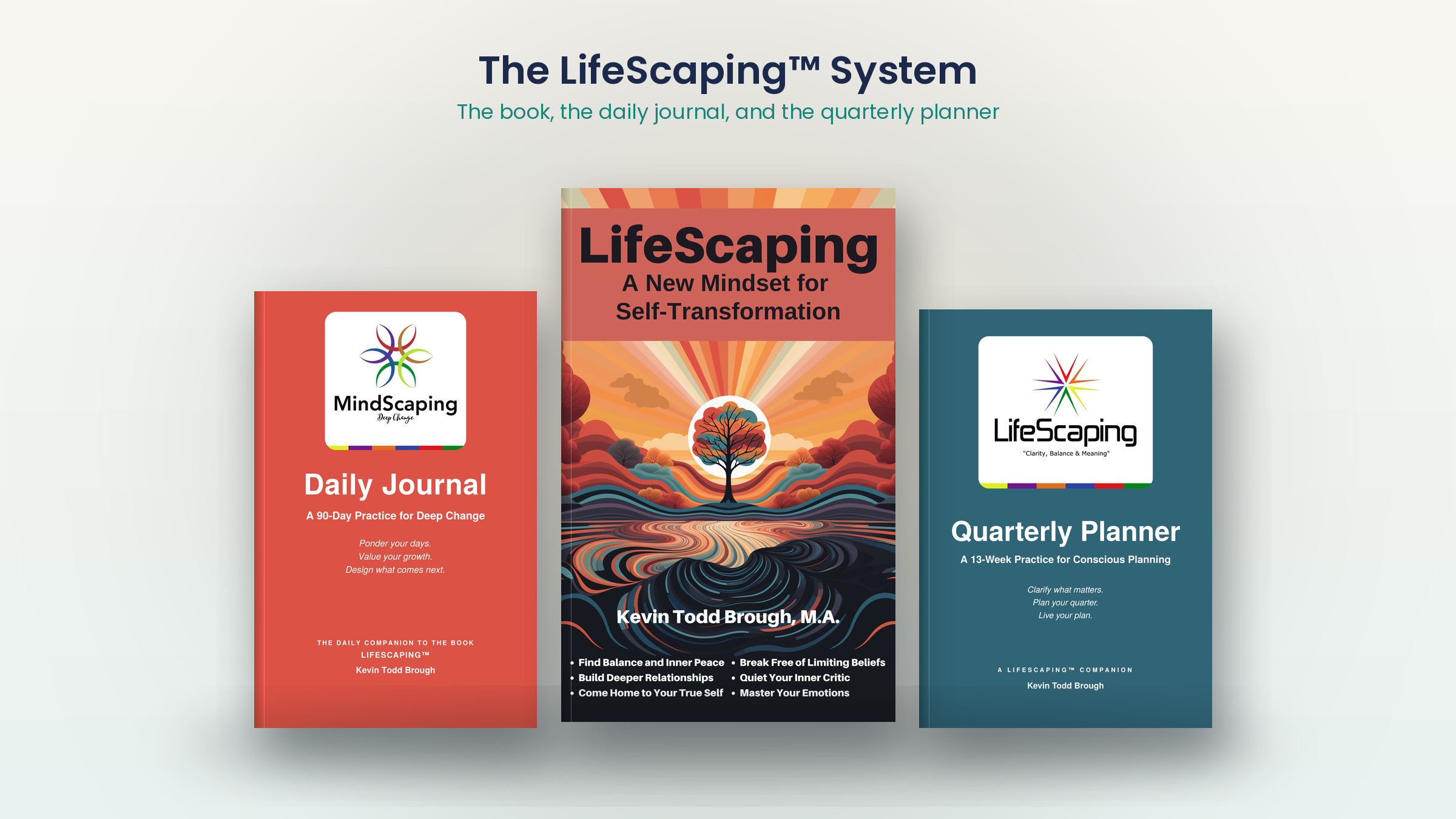
Three Books, One System: An Introduction to LifeScaping
Nov 5, 2026 · @Kevin Brough
By Kevin Todd Brough, M.A., C.Ht.
Two people have been on my mind for most of the last two years of writing.
The first is awake at 2 a.m. Someone she loves is using, and she has already been told, by him and by half the people she has confided in, that she is overreacting. She is not. She needs to know what she is looking at, what to say, and what to do when the conversation goes badly.
The second looks fine. Good job, decent marriage, kids launched or launching. And inside there is a quiet weariness that sleep never fixes, a sense of performing a life rather than living one. Sometimes this is the same person as the first, a few years on, after the crisis has passed and left her holding the question of what to do with herself now.
I have spent more than two decades sitting across from both of them, in detox units, residential programs, and now in a counseling office in St. George, Utah. I learned they need the same thing, delivered at different speeds. The family in crisis needs it fast and practical. The person rebuilding needs it slow and deep. Underneath both is one idea: you are not broken, and the best of you was never destroyed, only covered over.
That idea has a name in my work. It is called LifeScaping™, and this month, with the release of the LifeScaping book on November 9, the whole system is finally in print: three books, a planner, and a library of free online tools. This article is the map.
What LifeScaping is
LifeScaping is a method for redesigning a life from the inside out, like a landscaper works a piece of ground: first you see what is actually there, then you clear what doesn’t belong, then you plant on purpose. It is organized around four domains, Mind, Heart, Body, and Spirit, and it moves in three stages. The LifeScaping book follows the same three stages, one part each.
Master awareness. You cannot change what you cannot see. The first movement is learning to find your center and stand in it: who you are, how you were shaped, the inner critic and the shadow, what your emotions are for. The core practice here is the Vantage Point, which teaches you to step out of your own reactivity and look at your life from a stable, slightly distanced place. Psychologists call this self-distancing, and the research is consistent: people who can step back and observe their own experience regulate emotion better and ruminate less than people stuck inside it.
Reclaim your innate skills. Most people skip the second movement because it asks you to believe something about yourself that the last twenty years may have argued against: the capacity to change was never lost. The brain remains plastic throughout life. The skills in this stage are the ones I teach in the counseling room: the P3 Model™ (the Perception of Potential Pain), which names the pain a behavior is avoiding, since it is almost never the behavior itself; Belief-Busting™, for the stories formed young and defended hardest; the Releasing Practice™, for what you are still carrying; and the Significant Event Process™, which turns a setback or a win into something usable. These are cognitive and emotional reappraisal tools in plain clothes, drawn from clinical hypnotherapy, NLP, ACT, and narrative therapy, and stripped of jargon so a person can use them alone at a kitchen table.
Become congruent with your true intent. The third movement is design. Once you can clearly see what doesn’t belong, decide what you are for, name a governing purpose, and build a daily practice and weekly structure that match it. This is where the journal and the planner come in, because intent without a calendar is a wish.
None of this treats you as a problem to be fixed. It is biology-first and compassion-forward: the struggles that bring people to my office, including addiction, are usually a nervous system doing its best with the tools it was given. LifeScaping hands it better tools.
The books
Four titles, written to be read in whichever order your life demands.
You Are Not Overreacting
Recognizing & Responding to Substance Use Disorders in Someone You Love · Kindle, paperback, and hardcover · released October 30, 2026 · SUDGuide.com
This book is for the person doing the worrying. Nineteen chapters walk a family or friend through the whole arc: how addiction actually works in the brain, how to recognize what you are seeing, how to approach someone without driving them away, how to weigh intervention and treatment options, how to support recovery without enabling it, and, in the chapter most families skip, how to take care of yourself while you do it.
It tells nineteen real stories. Ten people made it, and nine did not, because a guide that tells only successes cannot be trusted about success. The later chapters go underneath the behavior, to the roots of craving, attachment, guilt and shame, grief, and couple recovery, and that is where this book borrows from LifeScaping. The P3 Model, Belief-Busting, the Releasing Practice, and the Significant Event Process appear here in short form because family members need them too.
LifeScaping: A New Mindset for Self-Transformation
Kindle, paperback, and hardcover · releasing November 9, 2026 · LifeScapingBook.com
This is the long-form teaching of the system described above: twenty chapters in three parts, Master Awareness, Reclaim Your Innate Skills, and Become Congruent With Your True Intent. It opens with my own story, including the near-fatal turning point that forced me to use these tools on myself, and it hands the reader the actual exercises, not just the theory. Where You Are Not Overreacting is for the family in crisis; LifeScaping is for the long rebuild afterward, whether addiction touched the life being rebuilt or years of running on empty.
MindScaping™ Daily Journal, Third Edition
A 90-Day Practice for Deep Change · available now · MindScapingJournal.com
The books explain. The journal is where the explaining stops. First published in 2005 and refined across two further editions, it is built around four short moves done in the receptive half hour before sleep: the MindScaping Account™ (valuing the growth work you actually did today), the Key Frustration Du Jour™ (turning the day’s sharpest frustration into a next step), Angels & Miracles™ (noticing the good you helped create), and the Goal Affirmation Script™ (pointing your mind at what you want most). You carry the four across a 90-day Power Quarter, with prompts that are deliberately full at the start and thin out as the practice becomes your own.
Why the evening? Because the hour before sleep is when the mind is most suggestible and the day’s experience is being consolidated. The two best-evidenced journal practices, structured gratitude and writing down a frustration as a concrete next step, work better when done at the same time every day, and bedtime is the one appointment nobody misses.
LifeScaping™ Quarterly Planner
A 13-Week Practice for Conscious Planning · available now · MyLifeScaping.com
Most planners help you get more done. This one starts with a different question: more of what? Thirteen undated weeks open with a guided Quarter Launch, where you rate twelve areas of your life on the Sacred Balance Wheel, name your values and governing purpose, and pick the three areas most worth your attention. Then one Quantum Leap a month, a single goal carried by one habit, broken into four weekly objectives, with an if-then plan written in advance for the obstacle most likely to stop you. Then an Ideal Week designed around the Six P’s of Time, with the rule that relationships and renewal go on the calendar first and the work arranges itself around a life.
The if-then plans are the planner’s quiet engine. Psychologists call them implementation intentions, and across more than a hundred studies they roughly double the odds that a stated goal gets acted on. The planner is the conscious half of a pair with the journal: planning by day, journaling by night.
The free online tools
Every practice named in the books is a working tool at VisionLogic.org, free, running in your browser, with no account and nothing you write leaving your device. These are the same tools I hand clients in session. The books teach them; the site lets you do them.
Assessments to see where you are. A Big-5 personality profile. The Attachment & Trauma Response Assessment: 40 questions that map your attachment style and default survival response under stress. The Shadow Dance Assessment, for the disowned parts that show up as judgment and reactivity. The Addiction Vulnerability Profile, which scores where risk actually sits across family history, early adversity, mental health, environment, and pattern of use. The LifeScaping Baseline Profile pulls several of these into one starting map.
Guided practices to do the work. The Vantage Point. The P3 Model. Belief-Busting. The Releasing Practice. The Significant Event Process, with one path for setbacks and another for wins. The Peace Building Process™, a sweep, sort, and clear that ends in a plan you can bring to a therapist. Each one saves and prints.
Daily and weekly structure. The Gratitude Suite at GratitudeSuite.com is structured, not vague, because gratitude is one of the few interventions with a clean evidence base and almost no cost to try. The Power QTR™ tool is the online version of the planner’s Quarter Launch. The Recovery Planner lays out supports, triggers, medication, routine, and what happens on a hard day. The Whole-Person Balance tool scores twelve life categories so effort goes where the gap is rather than where it is comfortable.
For families specifically. SUDGuide.com carries every tool You Are Not Overreacting points to, in chapter order, including the printable Family Worksheet Series: Signs I’m Noticing, the Intervention Planning Worksheet, the Trigger-Management Plan, the Self-Care Plan, the Family Contract, and the Boundary-Setting Worksheet. The site carries no advertising and takes no referral fees from any treatment provider.
A psychoeducation library. Thirty-one one-page guides, free to download and free to hand to someone else: the Window of Tolerance, the Four F’s of trauma, ACEs and resilience, the Stages of Change, attachment and repair, DBT skills, the emotion wheel, and more. Several chapters of both books stand on them.
These tools are educational, not a diagnosis and not treatment. The evidence on structured self-help is consistent on one point: it works best alongside a person, not instead of one.
How it all fits together
One way of seeing, expressed four ways.
- VisionLogic is the lens: holding many perspectives at once and building clarity out of complexity. It is the company, and it is the habit of mind everything else grows from.
- LifeScaping is the system: the three-stage method, its assessments, and its planners. HealthScaping™ and WealthScaping™ sit beneath it, the same method applied to the body and money.
- MindScaping is the daily practice: the journal, which turns the system into a habit in the half hour before sleep.
- IntelleWisdom is the teaching: the publishing imprint that turns frameworks from the counseling room into books, journals, and handouts, so what helps one person in a session can reach many.
Where to start depends on who you are.
| If you are… | Start with | Then |
| Worried about someone else’s drinking or using | You Are Not Overreacting and the family tools at SUDGuide.com | LifeScaping, when the crisis has passed, and it is your turn |
| Tired, divided, performing a life that looks fine | LifeScaping | The MindScaping Journal, started the week you reach Part Three |
| Ready to act and wanting structure, not more reading | The MindScaping Journal and the Quarterly Planner together | LifeScaping, one chapter a week alongside the practice |
| A clinician looking for tools to hand a client | The assessments and guided practices at VisionLogic.org | The psychoeducation library, free to print and share |
A last word
I wrote these books in the order my clients needed them, not the order I would have chosen. The family book came first because the phone kept ringing. LifeScaping came second because the people who called eventually asked the harder question: and now what about me? The journal and planner came next because knowing isn’t the same as doing, and a method that lives only in a book is a method nobody uses.
If you are the person awake at two in the morning, start at SUDGuide.com. If you look fine, LifeScaping is at LifeScapingBook.com on November 9, and the whole system is at MyLifeScaping.com. Either way: you are not broken, and you are not overreacting.
Kevin Todd Brough, M.A., C.Ht., is a marriage and family therapist in St. George, Utah; founder of VisionLogic Therapeutic Tools and the LifeScaping System; and author of You Are Not Overreacting, LifeScaping, the MindScaping Daily Journal, and the LifeScaping Quarterly Planner. All four are published by IntelleWisdom Publishing, an imprint of VisionLogic, LLC. LifeScaping™, MindScaping™, HealthScaping™, WealthScaping™, and the named practices are trademarks of VisionLogic, LLC.

