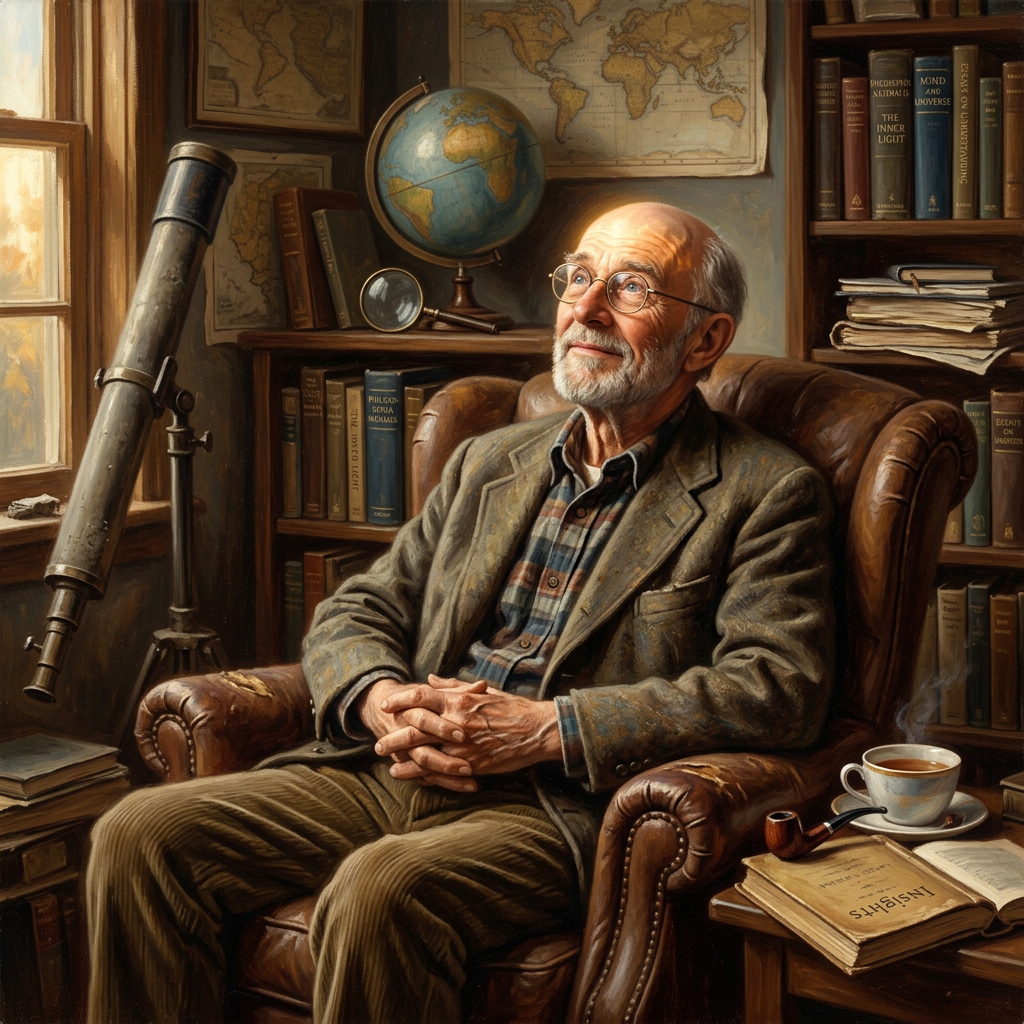
The Greater Intelligence Within
What cellular biology, consciousness research, and a wartime sermon by C. S. Lewis all seem to be saying
By Kevin Todd Brough, M.A., AMFT
VisionLogic Therapeutic Tools · The LifeScaping System
I sat recently with a client who is fighting cancer. We had been working together with clinical hypnotherapy and Neuro-Linguistic Programming (NLP) — not as a replacement for his oncology team, but as a companion to it. My aim in those sessions was simple on the surface and ambitious underneath: help him contact resources he did not yet know he had.
And that is the question that has been turning in my mind ever since. What resources, exactly?
Because the longer I practice, and the more I read across neuroscience, cellular biology, consciousness studies, and the spiritual traditions, the more it appears that the human being is wired to far more than shows up on an MRI. The body has intelligence. The subconscious mind has intelligence. And behind both, the traditions tell us, there is a larger intelligence still — one we participate in more than we generate.
If that is true, then human suffering may be more mutable than we have been taught to believe.
The Body Is Listening
In the late 1970s, a molecular biologist at the National Institute of Mental Health named Candace Pert made a discovery that quietly dismantled a three-hundred-year-old assumption. Since Descartes, Western medicine has treated the mind and the body as two distinct entities, separated by a narrow border at the brainstem. Pert’s research on neuropeptides — the chemical messengers we had thought lived only in the brain — showed that the receptors for these molecules are everywhere. In the gut. In the immune cells. In the endocrine glands. In the heart.
Her conclusion, published in Molecules of Emotion (Pert, 1997), was that what we call the mind is not confined to the skull. It is a distributed network of information that runs throughout the body, and every emotion you feel is also a molecular event in your immune system. She called it the bodymind, and the line for which she is most remembered is: “Your body is your subconscious mind.”
A few years later, a cell biologist named Bruce Lipton, working out of Stanford’s School of Medicine, began challenging another orthodoxy — that our genes determine our fate. In The Biology of Belief, Lipton (2008) drew on the emerging field of epigenetics to argue that the cell membrane, not the nucleus, is the true brain of the cell. What controls gene expression, in his view, is the signal the cell is receiving from its environment — and in the case of a human being, that environment includes the biochemistry of our beliefs, perceptions, and emotional states.
Lipton has his critics, and some of his rhetorical reach exceeds his data. But the broader epigenetic framework he helped popularize is now solidly established. Contemporary research consistently shows that psychological stress, social attachment, trauma, meditation, and prayer all leave measurable methylation signatures on the genome (Kaliman, 2019). The distinction between “psychological” and “biological” intervention, once tidy, has largely collapsed. Every thought is a molecular event. Every sustained belief has a biological echo.
Which brings us back to the consulting room, and to a question clinicians have always known the answer to but rarely said out loud: the client’s relationship to their illness is part of the illness — and part of the healing.
The Evidence of Psychoneuroimmunology
The science that studies this border crossing is called psychoneuroimmunology (PNI), and over the past four decades, it has produced substantial evidence that the mind modulates immune function through well-mapped neural and endocrine pathways (Rossi, 2002). Clinical trials have demonstrated that pre-surgical hypnosis reduces postoperative pain, nausea, and fatigue in breast cancer patients, with effect sizes comparable to pharmacological interventions (Kendrick et al., 2016). Hypnotic guided imagery has been associated with improvements in natural killer cell activity in cancer survivors (Bakke et al., 2002).
None of this means that hypnosis cures cancer. It means the patient’s inner life is doing biological work the whole time, and that skilled clinicians can help direct that work. When I guide a client into a deep state of inner rest, ask them to meet the wisdom of their own body, and invite them to picture their immune system as they would a loved one —strong, alert, welcome—I am not performing magic. I am helping them engage a system that Pert and her successors have been describing in peer-reviewed journals for forty years.
The Subconscious Has a Mind of Its Own
Anyone who has done deep therapy knows that the subconscious has capacities the waking mind does not. It remembers what the conscious mind has forgotten. It regulates the heart and the breath while we sleep. It gives us dreams that sometimes know things before we do. In clinical hypnotherapy, we routinely witness clients accessing memory, insight, and somatic regulation that were not available to them five minutes earlier in ordinary conversation.
The Scottish philosopher Sydney Banks, working outside academic psychology, articulated a simple framework that many clinicians have found useful. In Banks’s (1998) model, three principles — Mind, Consciousness, and Thought — generate the entirety of human experience. Mind, in his usage, is the universal intelligence behind life itself. Consciousness is the capacity to experience. Thought is the creative principle by which reality takes form in the individual moment-to-moment. Three Principles Psychology, as the approach is now called, has been applied in hospitals, schools, and correctional settings, and has accumulated a modest but growing peer-reviewed literature (Kelley, Pransky, & Sedgeman, 2017).
The clinical implication of Banks’s framework is deceptively simple. The feeling you are having right now is not coming from your circumstances. It comes from what you’re thinking about your circumstances. And behind the individual thinker — behind the anxious mind, the traumatized mind, the grieving mind — there is a larger Mind that is not the author of the suffering.
Noetic researchers at the Institute of Noetic Sciences have spent five decades asking whether that larger Mind is entirely metaphor, or whether something real is being pointed to. The Global Consciousness Project, run out of Princeton from 1998 to 2015, deployed a worldwide network of random number generators to test whether moments of intense collective human attention — major disasters, mass meditations, global inaugurations — correlate with measurable deviations from randomness. The cumulative effect across more than 500 pre-registered events was staggeringly unlikely to have occurred by chance (Nelson & Bancel, 2011). Interpretations remain contested, as they should be at this stage of the science. But the results are consistent with what contemplatives and mystics have claimed for thousands of years: that attention is nothing, and that we are, in some way we do not fully understand, participants in a larger field.
What Lewis Saw
Here is where a quiet Oxford professor comes into the story.
C. S. Lewis was not a scientist. He was a medievalist, a literary critic, and in his later years one of the most careful Christian writers of the twentieth century. But in the middle of the Second World War, in a sermon preached at the Church of St. Mary the Virgin in Oxford in June of 1941, Lewis said something that still strikes me every time I read it.
It is a serious thing to live in a society of possible gods and goddesses, to remember that the dullest and most uninteresting person you talk to may one day be a creature which, if you saw it now, you would be strongly tempted to worship… There are no ordinary people. You have never talked to a mere mortal. — C. S. Lewis, The Weight of Glory (1949/2001, p. 46)
Lewis was not speaking of what we can measure in a laboratory. He was speaking of what we can see in each other if we have the eyes for it. Every client who walks into a therapy office is, in his view, an immortal — carrying inside them a weight of glory that could, if we caught a glimpse of it fully, almost undo us. Every trauma survivor. Every addicted son. Every cancer-diagnosed husband. Every young adult with special needs sits in an Adult Special Needs Group on a Thursday night. There are no ordinary people.
Lewis’s other famous line — from Mere Christianity — speaks to the same depth from a different angle. Reflecting on the longings of the human heart that nothing in this world seems able to fill, he wrote:
If I find in myself a desire which no experience in this world can satisfy, the most probable explanation is that I was made for another world. — C. S. Lewis, Mere Christianity (1952/2001, p. 136)
It is a sentence that will mean different things to different readers, and that is as it should be. To a secular reader, it may mean that human consciousness is structurally oriented toward something bigger than its biology — a plausible claim that philosophers of mind have been making for decades in their own language. To a religious reader, it will mean something more. To a clinician, it means something practical: the client who has never felt whole in any earthly circumstance may not be broken. They may be correctly calibrated for a depth their circumstances have not yet matched.
And that, strangely enough, is a resource.
Spirituality Is Not a Nice Add-On
For a long time, the medical establishment treated spirituality as a private consolation, irrelevant to serious clinical work. That era is ending. Harold Koenig and his colleagues at Duke University have spent decades cataloging the peer-reviewed research, and the findings are remarkably consistent. In his 2012 review — synthesizing over 3,000 studies — Koenig reported that religious and spiritual engagement is associated with lower depression and anxiety, reduced suicide risk, better coping with chronic and terminal illness, stronger immune function, lower cardiovascular morbidity, and longer life expectancy. The Mayo Clinic Proceedings published a parallel review reaching the same conclusion (Mueller, Plevak, & Rummans, 2001).
You do not have to hold any particular theology to take that evidence seriously. Spirituality, across traditions, provides meaning, community, contemplative practice, moral structure, and a reliable way of relating to forces larger than the self. Each of those, independently, has well-documented health consequences. Together, they are a therapeutic resource that no medication can replicate.
For clients who carry a living spiritual framework — Christian, Jewish, Muslim, Buddhist, Hindu, Indigenous, or simply deeply humanist — that framework is an asset in the work. Some of the most powerful clinical moments I have witnessed have come when a client in trance contacted, in their own language, whatever they understand as the source of love and healing in the universe. For some, it is Christ. For some, it is God, or the Divine, or the Universe, or the wisdom of their own deepest self. The name matters to the client. What matters to the work is that they have found a door that opens.
Lewis would have said that all such doors open into the same country.
What This Means for the Client with Cancer
When I sit with the client I mentioned at the beginning of this piece, what we are actually doing is this. We are helping his conscious mind stop fighting his body. We are helping his subconscious mind know that his immune system is not the enemy and that fear is not a strategy. We are inviting him to imagine his healthy future in vivid, multisensory detail — not because wishing makes it so, but because the bodymind Pert described is listening, and what it hears becomes part of the environment his cells are reading. We are making room, in language that fits his own faith, for the greater intelligence he already believes in to be fully present in the room with us.
We are not promising him a cure. That would be a betrayal of both medicine and honesty. We are offering him an integration — so that his medical treatment, his relationships, his emotional life, his body, and his spirit are all pointed in the same direction at the same time.
That integration is itself a form of healing, even when a cure is not.
Four Practices for Contacting the Greater Intelligence
You do not have to be in therapy to take this seriously in your own life. The research reviewed here suggests four simple practices, each with meaningful evidence.
First, quiet the surface. Even eight weeks of daily mindfulness practice produces measurable changes in brain structure (Hölzel et al., 2011). The subconscious speaks most clearly when the conscious mind has stopped narrating. Ten minutes a day of silent attention is not a luxury. It is an infrastructure investment.
Second, listen to the body. Pain, fatigue, tightness, craving, and unease are not inconveniences. They are messages from a system that knows things the conscious mind has not yet noticed. A body scan — slowly and without judgment — is one of the most underrated clinical tools.
Third, refuse small thoughts about yourself. The evidence on belief and biology is clear enough now that self-contempt is no longer a neutral habit. It is a biological event. Lewis saw this from the other side of the same mountain — his insistence that there are no ordinary people is, among other things, a diagnosis of the central lie most of us have been told about who we are.
Fourth, keep the door of the spirit open. Whatever your tradition, stay in conscious relationship with the source of meaning in your life. Pray, if you pray. Read, if you read. Worship, if you worship. Walk in nature. Serve. Forgive. The research, the science, and the traditions all converge on the same finding: spiritual life is not decoration. It is infrastructure for a whole human being.
A Closing Word
We live in a strange time for the intersection of science and spirit. The hard boundaries are softening. The laboratories are asking older questions than they used to ask. And the ancient answers are turning out to be less naïve than the twentieth century assumed.
None of this lets us off the hook for honesty. I still believe in evidence-based medicine. I still believe clients in serious illness need their oncologists, cardiologists, and psychiatrists. I still believe that grandiose claims about consciousness curing cancer are a disservice to suffering people.
But I also believe — and the literature keeps nudging me further in this direction — that the human being is wired for more than we commonly admit, and that clinicians, chaplains, coaches, and ordinary friends can help each other remember. There is a greater intelligence within and around us. Call it what you will. Contact it however you can.
And when you sit across from a suffering human being, remember the sentence that an Oxford don preached in the middle of a war:
There are no ordinary people.
References
Bakke, A. C., Purtzer, M. Z., & Newton, P. (2002). The effect of hypnotic-guided imagery on psychological well-being and immune function in patients with prior breast cancer. Journal of Psychosomatic Research, 53(6), 1131–1137.
Banks, S. (1998). The missing link: Reflections on philosophy and spirit. Lone Pine Publishing.
Hölzel, B. K., Carmody, J., Vangel, M., Congleton, C., Yerramsetti, S. M., Gard, T., & Lazar, S. W. (2011). Mindfulness practice leads to increases in regional brain gray matter density. Psychiatry Research: Neuroimaging, 191(1), 36–43.
Kaliman, P. (2019). Epigenetics and meditation. Current Opinion in Psychology, 28, 76–80.
Kelley, T. M., Pransky, J., & Sedgeman, J. A. (2017). How the formless comes into form: A process by which Universal Mind powers Consciousness and Thought to create people’s psychological lives. Cogent Psychology, 4(1), 1307633.
Kendrick, C., Sliwinski, J., Yu, Y., Johnson, A., Fisher, W., Kekecs, Z., & Elkins, G. (2016). Hypnosis for acute procedural pain: A critical review. International Journal of Clinical and Experimental Hypnosis, 64(1), 75–115.
Koenig, H. G. (2012). Religion, spirituality, and health: The research and clinical implications. ISRN Psychiatry, 2012, 278730.
Lewis, C. S. (2001). The weight of glory (Rev. ed.). HarperOne. (Original sermon delivered 1941)
Lewis, C. S. (2001). Mere Christianity. HarperOne. (Original work published 1952)
Lipton, B. H. (2008). The biology of belief: Unleashing the power of consciousness, matter and miracles. Hay House.
Mueller, P. S., Plevak, D. J., & Rummans, T. A. (2001). Religious involvement, spirituality, and medicine: Implications for clinical practice. Mayo Clinic Proceedings, 76(12), 1225–1235.
Nelson, R. D., & Bancel, P. A. (2011). Effects of mass consciousness: Changes in random data during global events. Explore, 7(6), 373–383.
Pert, C. B. (1997). Molecules of emotion: The science behind mind-body medicine. Scribner.
Rossi, E. L. (2002). The psychobiology of gene expression: Neuroscience and neurogenesis in hypnosis and the healing arts. W. W. Norton.
Kevin Todd Brough, M.A., AMFT is an Associate Marriage and Family Therapist at Ascend Counseling & Wellness / Center for Couples & Families in St. George, Utah. He is the founder of VisionLogic Therapeutic Tools and developer of the LifeScaping System, an integrative framework organized around Mind, Heart, Body, and Spirit. He specializes in trauma, addiction recovery, couples and family work, ADHD; using CBT/DBT/ACT, SFBT, Narrative Therapy, and integrative modalities including clinical hypnotherapy, NLP, and ketamine-assisted psychotherapy.
This article is offered for educational and reflective purposes. It is not a substitute for medical or psychological care. Clients facing serious illness should always work within a medically supervised treatment plan.

