
Breathe

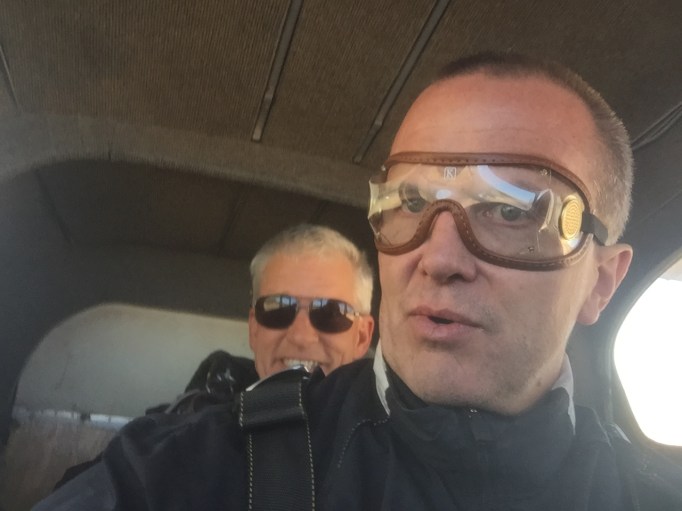
The view of our ranch www.theretreatatzion.com from the plane although beautiful was also looking like a long way down. My beautiful daughter Emily had chosen Sky Diving as a present for her 19th birthday and dad was along for the flight, fall , and float experience.

I quickly and instinctively chose deep breathing as a simple yet powerful relaxation technique to use pre-jump. It’s easy to learn, can be practiced almost anywhere, and provides a quick way to get your stress levels in check. Deep breathing is the cornerstone of many other relaxation practices such as Yoga, Meditation, and other self regulation tools we teach and use at The Retreat At Zion (RAZ).

Pre Jump

Breathing away the stress!!!!!!!!

Thank You        skydivezion

Adversity

Eagle Crag Header

Each person’s peace and happiness, both now and long term, may depend largely on his or her responses to the trials of life.

Adversity and trials come from different sources. (1)Trials may come as a result or consequence of a person’s own decisions and actions. These trials can be avoided through learning from mistakes and taking the right actions. (2)Other trials are simply a natural part of life and are not a result of any poor decisions and in fact may come at times when people are doing their best. For example, people may experience trials in times of sickness, uncertainty, or from the deaths of loved ones. (3)Adversity may sometimes come because of others’ poor choices, hurtful words, and actions.

How we face adversity will determine the long term outcome of such trials. When we ask questions like “Why does this have to happen to me? Why do I have to suffer this now? What have I done to deserve this?” These questions have the power to dominate our thoughts. Such questions can overtake our vision, absorb our energy, and deprive ourselves of the experiences and insights we need to learn and grow from trials and tribulation. Rather than responding in this way, people should consider asking questions such as, “What am I to do? What am I to learn from this experience? What am I to change? Whom am I to help? How can I remember my many blessings in times of trial?”

Different kinds of adversity require different responses. If a person’s trials come because of their own poor choices, he or she should (1) correct the behavior and humbly seek to learn from their mistakes. Remember weakness is not sin. Remorse should be resolved not turned into shame. People who are stricken with illness or other trials may simply need to be (2) patient, positive, and faithful. People who suffer because of others’ words or actions should (3) not take it personally and work toward forgiving those who have offended them, so that the negative energy of anger does not cause more damage than the original offense itself. Victims of abuse however should seek help immediately and set boundaries to prevent future abuse.

Inner Voice II

redrockheader5Part II of a series on Empowering Language Patterns:

Get rid of the word “BUT”

But….used in the most common way, negates the positive that came before!! (Thank you for getting the groceries, but you forgot the milk.) It stops the brain then restarts the new statement leaving the prior portion of the message unheard – alone (in the dust)….the brain moves on to what follows the but. So, only use but to turn a negative into the positive (I know you wrecked the car but at least you did not get injured).

You can substitute the word “and” & “however” for but and it minimizes the damage caused by the negation (I went shopping at the health food store and on the way home I ate a Big Mac.). Think of how that sentence would feel with the word but instead of and. This helps us be more positive, resourceful and more motivated. An example would be (You did better on your grades this semester however there is room for improvement in math).   You did “x” for me and you forgot “y” (keeps the sentence continuous and the full message unit stays intact. The word but turns it into a more negative message unit going to your subconscious since the part after but is what is encoded).

Speaking this way with ourselves is kinder and gentler and it lays the foundation to speak the same with others.

A way to even enhance this speech pattern change is using the sandwich effect. This is sandwiching any negative or paternal statement in between two positives (Positive/Negative(Correction)/Positive). It helps us abstain from the defensiveness and packages the negatives with a positive feeling. This pattern would go something like this (It was great I did Yoga this morning, however I need to do it several times a week. Since in the past I practiced Yoga on a daily basis with such great results that means I can do it again starting with that class today.).

Empowering language patterns for ourselves and others;-)

Attachment Style

Why do Attachment Styles affect our relationships?

Experience with early caregivers forms a working model, or RELATIONSHIP SCHEMA that impacts later relationships.

Secure Working Model

  • Others are dependable, trustworthy, and supportive (benefit of the doubt).
  • I am worthy of other people’s support and love.

62% are SECURELY ATTACHED:

As a Child

  • Mother as a safe base.
  • Upset when she leaves.
  • Go to her lovingly when she returns.

As an Adult

I find it relatively easy to get close to others and am comfortable depending on them and having them depend on me. I don’t worry about being abandoned or about someone getting too close to me.

Insecure Working Model

  • Others are expected to be undependable, untrustworthy, and UN-supportive.
  • I am unworthy of other people’s support and love.

23% are AVOIDANT:

As a Child

  • Initially do not seek proximity to the mother.
  • Very little distress upon separation.
  • Avoid/ignore her when she returns.

As an Adult

I am somewhat uncomfortable being close to others; I find it difficult to trust them completely, difficult to allow myself to depend on them. I am nervous when anyone gets too close, and often, others want me to be more intimate than I feel comfortable being.

15% are RESISTANT (AMBIVALENT):

As a Child

  • Preoccupied with mother (Clingy).
  • Great distress when the mother leaves
  • Simultaneously seek close contact but also hit and kick (punishment).

As an Adult

I find that others are reluctant to get as close as I would like. I often worry that my partner doesn’t really love me or won’t want to stay with me. I want to get very close to my partner, and this sometimes scares people away.

HMMM? Something to think about.

Awareness provides fertile ground for Transformation!

Free Agency

I believe the determinist view that desires are the cause of all actions we take, is not a truly accurate viewpoint of what determines either deliberate or unintentional actions. I do think that many behaviors are determined by our thinking and motivated by feelings that those thoughts bring about. The problem with determinism alone as the explanation of all action is that our intentions versus behavior are a far more complicated than just desires alone. Determinism alone does not explain the full complicated process of human behavior.
The duality of man is maybe more than a struggle in between just two parts of the individual. I can see how at times the heart, mind, body, and spirit all have different agendas and that a person’s actions both individually and in pattern are not just a result of this struggle but of even many more additional forces. The additional impact of the past through memories and prior experience can effect greatly how one interprets the present and perceives the future and that can cause someone to act in ways in-congruent with who they are and what they want. The pressure put on individuals by significant others, groups, and society also effect greatly a person’s actions and behaviors. Does a person truly have autonomy and freedom to do as they want, I don’t think fully, due to all of these contributing factors. But all actions are not determined.
Freedom over automatic subconscious actions comes through awareness. The more one works to bring the heart, mind, body, and spirit into a harmonious and symbiotic relationship the more a person can learn to act consciously and have their intentions and actions aligned. Emotions do carry all of the energy used to motivate actions but those energies can be rerouted to meet objectives and higher motives than just desires. The context in which one acts certain ways can be changed to be integral with behaviors that have a higher purpose. Integrity means to come together and honor all of you. When this is done the freedom of more conscious choices increases. The opposite is also true when people give into base desires or addictive thoughts, feelings, and behaviors, freedom is diminished.
The interpretation of memories and experiences that drive autonomic reactions when we perceive similar situations can drive behavior before thought. Man can also choose to relearn or put into new contexts those same prior experiences and change their interpretations of the past. In this way a person can change the meaning of their past learning’s and take back the power of conscious choice. As context and meaning changes so will the actions and behaviors. When we are open to change we can learn to live more as we intend to, instead of deliberate or unintentional actions that really are not congruent with the intentions of our hearts.
People can also learn to walk a path that is true to their own self instead of trying so much to please others, fit in to a group, or societal norms.

When you break free of expectations I believe you are also free to be as you want to be and do what you truly want to do. Re-framing beliefs, waking up and being aware more of the time, and being true to ourselves before others will bring more freedom. Determinism does not take into account so much of what causes or influences behavior and even though we go on auto pilot too often, we can have more and more freedom than we think we can, and we deserve it.