Health Recovery
Current Views On Addiction
The subject of addiction brings up many opinions and beliefs. These views on addiction can greatly affect ideas on what is addiction, if it’s possible to stop or recover from addiction, and what are the best ways to treat or overcome addiction if it is possible (Sellman, 2009). An addict, loved one of an addict, or a professional treating addiction has to wonder at times is addiction a lack of will power, a psychological or emotional issue, a chronic illness, a progressive disease, or a combination of all of the above?
Addiction comes in many forms but the process of becoming addicted and the progression of the disease has many commonalities that are better understood today than ever before. Whether the addiction is to a substance, a pleasurable activity, or a process the transition from a genetic vulnerability to a disease that changes the structure and function of the brain is similar in various ways (HMHL, 2011). First the desired subject/object/action stimulates Dopamine and other neurotransmitter activity and interaction in the brain, bringing about pleasure or reward. The speed and consistency of the result determines the strength of the connection made in between stimulus and pleasure (HMHL, 2011). As this hedonic drive moves from desire to need the motivation to seek the pleasure is increased. Eventually this pleasure seeking mechanism becomes more of a compulsive unconscious obsession as the limbic system goes on auto pilot with the amygdala whispering heavily emotional lies about how great the pleasure really was. Even though tolerance has eroded the majority of the pleasure, many parts of the experience have become directly linked to the past pleasurable results that it triggers the frontal cortex to shut down and the limbic system to take over when triggered (HMHL, 2011).
Once one is in the trenches of addiction how can this all-encompassing subconscious automatic behavior become interrupted to the point of causing a shift in awareness or an epiphany that the strategy that once worked in finding pleasure now just brings them pain and sorrow (Sellman, 2009). When in the grip of addiction it is difficult to stop without motivators. This is not due to a lack of desire or will; it’s simply due to the fact that the majority of the pattern has become an autonomic reaction in the brain far from consciousness (HMHL, 2011). You need to have awareness before ownership and transformation can take place. Because addiction is full of stealthy memories in the brain that have such strong emotional content that can be triggered at any minute by recalled data throughout the visual and sensory cortex, recovery will take time (HMHL, 2011). Addicts need to move through the stages of change at their own pace based upon their own intentions and development (Sellman, 2009). New strategies and skills for self-regulation and behavioral & lifestyle modification will be the most important parts of that development.
All forms of therapy get results (Sellman, 2009). Like the law of inertia the addict will need to put apposing energy, time, and work into moving in a new direction. Energy equal to what they put into obsessing about, seeking, and using that which they were addicted too. There is not one answer for all alcoholics and addicts (Sellman, 2009). A person needs to on one hand find what will work for them, while on the other hand be open and teachable. Programs need to take a person centered, humanistic approach; tailoring treatment plans to address the individual uniquely and holistically to get best results (Sellman, 2009). Both physical and behavioral co-occurring conditions that acerbate the addiction need to be addressed, (since such a high percentage of addicts have psychiatric and other comorbidity factors) and the continuum of care needs to support recovery for as lengthy a time as possible (Sellman, 2009). Relapses although not excusable are part of the disease and should be expected as part of recovery. Learning from relapses may be as important as relapse prevention in supporting one on the journey of healing and recovery (Sellman, 2009). Only when physical, emotional, mental, and spiritual needs are being met in healthier ways can an addict fully recover from addiction.
The time has come to combine the best evidence based traditional and complimentary medical treatments with therapeutic approaches that reach and support an addict in recovery, meeting them where they are at and helping them make the steps needed to overcome that which enslaves them (HMHL, 2011). This will only occur as old beliefs and opinions are discarded for the current view on addiction prevention, intervention, treatment and recovery. More providers, caregivers, therapist, social workers, and school counselors etc., that end up being the first point of contact so often for addicts, need to be more aware of intervention skills and open to helping their clients/patients find the resources for help earlier in the addiction cycle (Sellman, 2009).
References
How addiction hijacks the brain. (2011). Harvard Mental Health Letter, 28(1), 1-3. Retrieved from http://www.health.harvard.edu
Sellman, D. (2009). The 10 most important things known about addiction. Addiction,105, 6-13. doi:10.1111/j.1360-0443.2009.02673.x
Self Regulation
If you want Peace, Love, & Joy you need to learn to CREATE IT!
Vantage Point
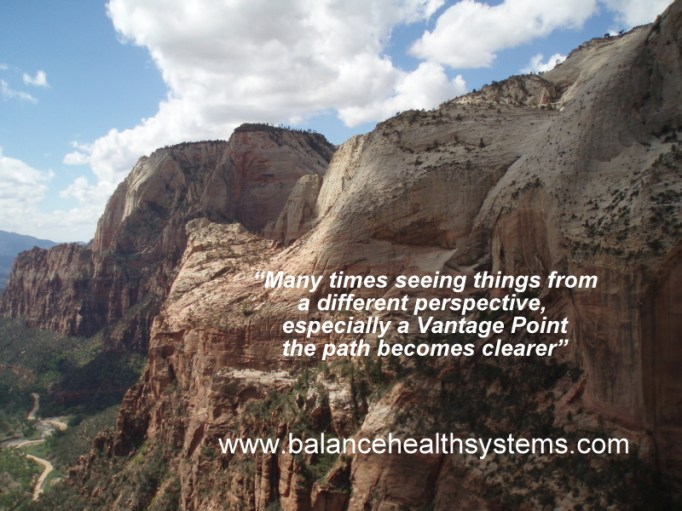
This beautiful shot in Zion National Park by one of our employees is a great Metaphor on perspective. When we come together and get centered we have an internal “Vantage Point” where we see using all of the resources of body,heart,mind, & spirit at the same time.
We tap our internal wisdom and with deeper awareness make far better choices.
Physical Health Leads the WAY
Balance Health Systems believes as physical health is restored, mental processes shift, emotions are released, and self-reclamation occurs. Patients acquire a new awareness and can take the right actions & gain empowering new behavior patterns. Better life strategies get better results, which motivates the permanent adoption of a healthier lifestyle. This supports a balanced life and continued long-term improvement of health, autonomy, growth, and contribution. Meaning and light returns.
The BHS Progressive Social Detoxification, is a medically managed alternate titration from drugs or alcohol along with nourishment & rejuvenation protocols that are customized specifically to your needs. Our system will change brain and body chemistry, restoring cellular and system balance, reclaiming and resetting a healthy homeostasis.
Recovery Support Programs are integrated medical care packages that include evidence-based traditional and complementary treatments to support healing from common co-occurring health conditions such as:
Mood Disorders, Anxiety Disorders, ADHD, PTSD, Memory Issues, Chronic Health Problems, Auto Immune Disorders, Chronic Pain, Headaches, Insomnia and much more.
Neural Re-patterning Programs™ are a scientific approach to Neuro-Electro-Chemical Brain and Body Balance & Health. These Programs combine multiple treatment approaches proven to have positive powerful life-changing behavioral results.
Our focus not only addresses the brain, but also helps restore the mind and body to their most natural, balanced, relaxed, and resourceful state. Body work including massage, acupuncture, and other modalities combined with infrared sauna, photo-tonic therapy, and hyperbaric chamber treatments accelerate the healing transition.
Call today and you can talk to an intervention and recovery specialist within minutes.
If you feel like you need support right away, please call now 435-574-9120
• Private and confidential
All communications with your intervention coach are held in strictest confidence
• A welcoming environment
Beautiful, comfortable & homey facility creates a pleasant therapeutic environment
• Convenient location
We’re 10 minutes from the St. George Airport and 1 hour and 20 minutes from the McCaran International Airport in Las Vegas, Nevada
Live Alive!
 Balance Your Health